Whether you’re rolling a dice on a game board or considering the chances of winning the lottery, probability is a useful and commonly used mathematical concept in day-to-day life. But that doesn’t mean it’s easy to understand or calculate. Luckily, this step-by-step guide will give you the skills you need to calculate probability quickly and accurately. Before you know it, calculating probability will become second nature to you!
What is probability?
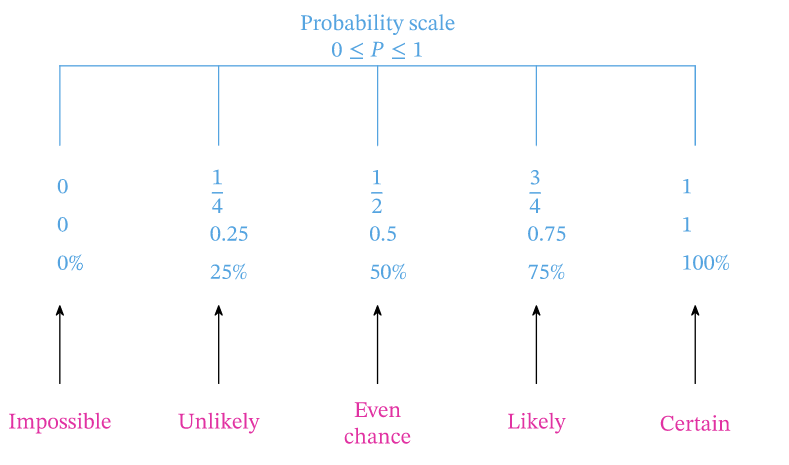
Probability is a measure of how likely it is that something will happen. The probability of an event occurring can be calculated by dividing its favorable outcomes in a set of observations by its total possible outcomes. Probability (denoted as the letter P in equations) is a scale between zero and one where 0 indicates impossibility and 1 means certainty. Probability is often written as a decimal, fraction, percentage, or in words.
Probability is the likelihood of an event occurring. It is calculated by dividing the favorable outcome by the total number of possible outcomes.
Example- probability of flipping a head The probability (P) of us getting heads during a fair coin flip can be calculated by using the formula:
Probability = \( {\text{Event Outcomes} \over \text{Total Outcomes}}\) Probability = \( {1 \over 2}\) Using a coin we only have 1 chance to get heads because only one side has that option, but we have a total of two options because the coin can land on heads or it can land on tails. This equates to a probability of 1/2 (fraction), 0.5 (decimal), 50% (percentage), or equally likely (even number of chances to get the favorable or unfavorable outcome)Some events are extremely unlikely—such as seeing your exact birth date on a calendar. Others occur frequently, such as flipping a coin twice and getting heads each time.
Theoretical Probability
Probability is often initially presented as a theory. We say theory because we base our decision from the information we have readily available before we conduct any experiments. Using our coin flip example we know there are two possible outcomes for flipping a coin: heads or tails. Knowing that there are only two options (and assuming it is a fair die) lets us know that the chance of landing on heads is equally likely as the chance of landing on tails because we only have two options in our sample space - a list of all possible outcomes.
Let's look at another example!
Example- rolling an odd number on a fair six-sided die Probability = \( {\text{Event Outcomes} \over \text{Total Outcomes}}\) Lets firstly use a sample space diagram to show all the possible outcomes.
| Die 1/Die 2 | 1 | 2 | 3 | 4 | 5 | 6 |
|---|---|---|---|---|---|---|
| 1 | (1,1) | (1,2) | (1,3) | (1,4) | (1,5) | (1,6) |
| 2 | (2,1) | (2,2) | (2,3) | (2,4) | (2,5) | (2,6) |
| 3 | (3,1) | (3,2) | (3,3) | (3,4) | (3,5) | (3,6) |
| 4 | (4,1) | (4,2) | (4,3) | (4,4) | (4,5) | (4,6) |
| 5 | (5,1) | (5,2) | (5,3) | (5,4) | (5,5) | (5,6) |
| 6 | (6,1) | (6,2) | (6,3) | (6,4) | (6,5) | (6,6) |
Always reduce fractions to simplest form!
Compound Events in Probability
Compound events are 2 or more events that take place one after the other or at the same time. Compound events use special rules to calculate their probabilities depending on if the events are independent or dependent. An example of a compound event would be flipping a coin and rolling a die.
Addition Rule
The universal set is a box. All the possible outcomes are inside the box. The shaded region is the probability that event A or event B will both occur. The events overlap so it is possible that both event A and B occur.
The universal set has been reduced to circle B. All the possible outcomes are inside the box. The shaded region is the probability that event A or event B will both occur. The events do not overlap so it is impossible that both event A and B occur. We say that events A and B are mutually exclusive
P(A or B) = P(Event A) + P(Event B) - P(both Event A and Event B occuring)
This can be seen in the shaded region left-hand picture above. This can be expressed using mathematical notation.
P(A∪B) = P(A) + P(B) - P(A⋂B)
It is possible that both events A and B can not occur such a rolling an even number and a 3. This is an example of events being mutually exclusive.
In this case P(A⋂B) = 0. For mutually exclusive events:
P(A∪B) = P(A) + P(B)
In simpler terms, the probability P of event A or event B is equal to the sum of the probability of event A and the probability of event B.
Conditional probability
Conditional probability is the probability that event A will happen, given that B has taken place. We can show this using a Venn diagram.The universal set is a box. All the possible outcomes are inside the box. The shaded region is the probability that A and B will both occur.
The universal set has been reduced to circle B. All the possible outcomes are only inside the event B. The shaded region is the probability that A will occur given that B has already happened.
P(A|B) = \( {P(A⋂B) \over P(B)}\)
This can be rearranged to
P(A⋂B)=P(A|B)P(B)
This is referred as the Multiplication Rule
Independent Events in Probability
Events A and B maybe independent, for example the event of rolling a 6 and a coin landing on heads. Whatever a die rolls, does not affect the probabily of a coin landing on heads. P(A|B) = P(A) Independent events are independent if their outcome is not affected by another event. Again, we refer to our example of flipping a coin and rolling a die. These are independent events because flipping the coin and landing on heads or tails will not affect the outcome of rolling the die and landing on a number between 1 and 6, or vice versa.Multiplication Rule for Independent events
This rule is used when calculating probability of independent events. Simply, an event is independent if its probability does not change based on past or future events. For example, rolling doubles when playing with dice. This is representative of a independent event because rolling the first die will not affect the outcomes of rolling the second die. Both dice have the probability of landing on a number 1 through 6 regardless of what the other die lands on. The Multiplication Rule states that: P(A⋂B) = P(A)P(B)
Example- probability of rolling double 4s with fair dice)
We already know that the probability of rolling a four on one die is 1/6 (because there is one 4 on a each six-sided die), so we would multiply the probabilities of both die together to get the probability of this event occurring.
P(rolling a double 4 with fair dice) = \( {\text{Event Outcome} \over \text{Total Outcomes }}\)
P(rolling a double 4 with fair dice) = \( {1 \over 6} {1 \over 6}\)
We can understand this a bit better visually using a table. Look at all the possible outcomes that could happen when we try to get double 4s.
|
|
1 | 2 | 3 | 4 | 5 | 6 |
| 1 | 1, 1 | 2, 1 | 3, 1 | 4, 1 | 5, 1 | 6, 1 |
| 2 | 1, 2 | 2, 2 | 3, 2 | 4, 2 | 5, 2 | 6, 2 |
| 3 | 1, 3 | 2, 3 | 3, 3 | 4, 3 | 5, 3 | 6, 3 |
| 4 | 1, 4 | 2, 4 | 3, 4 | 4, 4 | 5, 4 | 6, 4 |
| 5 | 1, 5 | 2, 5 | 3, 5 | 4, 5 | 5, 5 | 6, 5 |
| 6 | 1, 6 | 2, 6 | 3, 6 | 4, 6 | 5, 6 | 6, 6 |
The probability of rolling double 4s is 1 out of 36 possible because there is only one outcome out of all the 36 possible outcomes that is a (4,4).
Dependent Events in Probability
In probability, one of the main concepts is dependent events. Dependent events occur when the outcome of the first event changes the size of the sample and/or affects the probability of the second event.
An example of a dependent event is when you win the lottery. A ticket must be purchased first to win the prize. However, if you only buy one ticket, the odds of winning are 1 in a million. But, if you don't purchase a ticket, the chances of winning the lottery are zero.
We must know the types of events in order to understand the probabilities. Dependent events use the Multiplication Rule with a slight change to the formula. The Multiplication Rule for dependent events is:
As we can see the probabilities of each event are multiplied but the probability of event (B) will be different following event (A).
Let's say we have a bag of 6 marbles. We start with 3 red marbles, 2 blue marbles, and 1 green marble. What is the probability of choosing a red and a green marble when drawing one marble at a time and not replacing the first marble?

P(red and green) P(red on first draw) = \({3 \over 6}\) (3 red marbles out of 6 marbles total; do not return marble to the bag) P(green on next draw): \({1 \over 5}\) (1 green marble out of 5 marbles remaining) P(red and green) = \({3 \over 6}\) x \({1 \over 5}\) = \({3 \over 30}\) = \({1 \over 10}\)
In the above example we have a 1 out of 10 chance of drawing a red marble followed by a green marble.
Probability - Key takeaways
- Probability is the chance of an event occurring.
- Theoretical Probability is the chance of an event occurring before any experiments or trials.
- Experimental Probability is the probability of an event occurring during a set number of trials.
- Compound events are 2 or more simple events.
- Independent events do not affect the outcome of other events.
- Mutually exclusive events are events that happen one after the other.
- Dependent events affect the sample size and outcome of future events.
